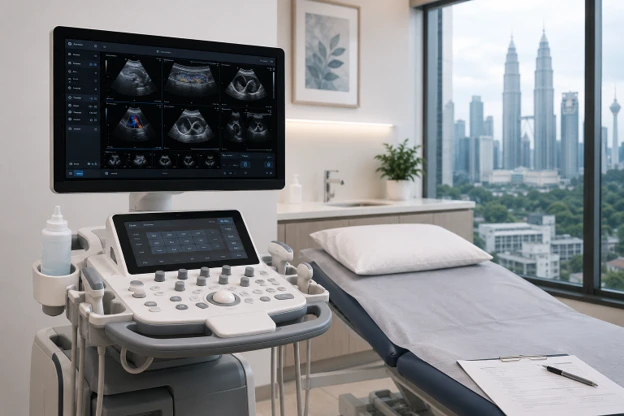
Being asked to undergo an ultrasound scan can raise several questions.
Why has your doctor recommended it? Do you need to fast? Will it hurt? How long does the scan take, and what happens if something unusual appears?
Ultrasound is a widely used diagnostic imaging method that allows healthcare professionals to view structures inside the body without using ionising radiation. It may be recommended to investigate symptoms, monitor an existing condition or provide additional information following a physical examination or other test.
Understanding what happens before, during and after the scan can help you prepare appropriately and know what to expect from your appointment.
What Is an Ultrasound Scan?
An ultrasound scan, sometimes called sonography, uses high-frequency sound waves to produce images of structures inside the body.
A handheld device called a transducer or probe sends sound waves into the body. These waves bounce back differently depending on the tissues and structures they encounter.
The ultrasound machine processes these returning echoes and converts them into images that can be viewed on a monitor.
Because the images are produced in real time, healthcare professionals can examine the shape, position and movement of certain internal structures while the scan is being performed.
Ultrasound does not use the ionising radiation used by X-rays and CT scans.
Why Might a Doctor Recommend an Ultrasound Scan?
An ultrasound scan is usually performed for a specific clinical reason rather than simply to “look inside the body”.
A doctor may recommend one to:
- investigate persistent pain or discomfort;
- assess a lump or swelling;
- investigate abnormal findings from a physical examination;
- monitor a known medical condition;
- investigate abnormal blood or urine test results;
- evaluate soft tissues or internal structures;
- monitor certain changes over time;
- support pregnancy assessment; or
- obtain additional information before deciding whether further investigation is necessary.
For example, if a physical examination or medical check-up and health screening identifies an unusual finding, your doctor may recommend imaging to gather more information.
An ultrasound result should therefore be viewed as one part of the broader diagnostic process rather than as a standalone diagnosis.
How Is an Ultrasound Different From an X-Ray?
Both ultrasound and X-ray are imaging tools, but they work in different ways.
An ultrasound creates images using sound waves. An X-ray uses a small amount of ionising radiation to create images, particularly of structures such as bones and the chest.
Which test is more appropriate depends on what the doctor needs to investigate.
For some health concerns, ultrasound may provide the information required. For others, an in-house digital X-ray or another form of imaging may be more suitable.
Sometimes more than one type of investigation is needed because different imaging technologies provide different types of information.
Is an Ultrasound Scan Safe?
Diagnostic ultrasound is generally considered a safe imaging technique when used appropriately by trained healthcare professionals.
Unlike X-rays and CT scans, ultrasound does not expose the patient to ionising radiation. This is one reason ultrasound is widely used in clinical care, including pregnancy imaging.
However, this does not mean that everyone needs ultrasound screening without a clinical reason.
Like other medical investigations, an ultrasound should ideally answer a specific health question or support an appropriate medical assessment.
Do You Need to Prepare for an Ultrasound Scan?
Preparation depends on the area being examined and the purpose of the scan.
There is no single preparation rule for every ultrasound examination.
Your clinic may ask you to:
- avoid food for several hours before the appointment;
- drink water before arriving;
- maintain a full bladder;
- wear comfortable, loose-fitting clothing; or
- follow no special preparation at all.
For some abdominal examinations, fasting can help improve the visibility of certain structures. For some pelvic or urinary assessments, a full bladder may improve the images.
Klinik Len Seng’s ultrasound scan service provides preparation instructions according to the examination being performed.
Always follow the instructions provided for your specific scan, rather than assuming that advice given to another patient applies to you.
Do You Always Need to Fast Before an Ultrasound?
No.
This is one of the most common misunderstandings about ultrasound preparation.
Fasting may be required for certain examinations, but many ultrasound scans do not require fasting at all.
If fasting is required, your clinic will usually tell you:
- how many hours to avoid food;
- whether you may drink water;
- what time to stop eating; and
- whether there are any specific instructions regarding medication.
Do not change or stop prescribed medication simply because you are having an ultrasound unless a healthcare professional has specifically instructed you to do so.
If your appointment instructions are unclear, confirm with the clinic before the day of the scan.
Why Might You Need a Full Bladder?
For some examinations, a full bladder helps create a clearer view of structures in the pelvis.
The fluid in the bladder can improve the pathway for the ultrasound sound waves and may help position surrounding structures so that they are easier to examine.
If a full bladder is required, you may be instructed to drink a certain amount of water before your appointment and avoid going to the toilet until the scan is completed.
The amount and timing can vary, so follow the instructions provided by the clinic rather than using a general rule from the internet.
What Happens During an Ultrasound Scan?
For a typical external ultrasound, you will usually be asked to lie or sit in a position that gives the healthcare professional access to the area being examined.
A clear water-based gel is applied to the skin.
The gel helps remove air between the probe and your skin so the ultrasound waves can travel effectively.
The healthcare professional then moves the probe over the area while watching the images on the monitor.
During the examination, they may:
- change the angle of the probe;
- apply gentle pressure;
- ask you to change position;
- ask you to take or hold a breath;
- take measurements; or
- save selected images for review.
Once the scan is completed, the gel is wiped away and you can usually continue with your normal activities.
Does an Ultrasound Scan Hurt?
Most external ultrasound examinations are painless.
You may feel the probe moving across your skin and some pressure as the healthcare professional obtains the required images.
If the area being examined is already sore, swollen or tender, that pressure may feel uncomfortable.
Tell the healthcare professional performing the scan if you experience pain or significant discomfort. They may be able to adjust the pressure or your position.
The sound waves themselves cannot be felt.
How Long Does an Ultrasound Scan Take?
The duration depends on the area being examined, the reason for the scan and how many images or measurements are required.
Many ultrasound examinations can be completed within approximately 10 to 45 minutes, although some may take longer when more detailed assessment is needed.
You may also need additional time for registration, preparation or discussion with the healthcare professional.
It is therefore useful to check with the clinic when booking if you need to plan around work or another appointment.
Can You Eat or Drive After an Ultrasound Scan?
After a routine external ultrasound without sedation, most people can return to their normal activities immediately.
You can generally:
- eat and drink normally;
- return to work;
- drive; and
- continue with everyday activities.
If you were asked to fast beforehand, you can usually eat again once the examination is completed unless you have been given different medical instructions.
Procedures involving sedation or more specialised forms of ultrasound may have different aftercare requirements.
When Will You Receive Your Ultrasound Results?
The timing of ultrasound results varies.
In some situations, preliminary findings may be discussed during or shortly after the examination.
In other cases, the images need to be reviewed and interpreted before a report is completed.
The important step is not simply obtaining the report but understanding what the findings mean in relation to your symptoms, examination and other medical results.
Your doctor may explain whether:
- the scan appears normal;
- the finding needs monitoring;
- another investigation is required;
- treatment should be considered; or
- referral for further assessment is appropriate.
If you do not understand a term in your ultrasound report, ask your healthcare professional for clarification rather than trying to diagnose yourself based on the wording alone.
What Does an Abnormal Ultrasound Result Mean?
An abnormal ultrasound finding does not automatically mean that you have a serious condition.
Ultrasound may identify many different findings, some of which may be minor, benign or require only monitoring.
Depending on the finding, your doctor may recommend:
- observation;
- repeat ultrasound after a period of time;
- blood or urine testing;
- another imaging test;
- treatment;
- additional clinical examination; or
- referral to another healthcare professional.
The importance of a finding depends on factors such as its appearance, size, location, your symptoms and your medical history.
This is why ultrasound results should be interpreted within their clinical context.
Can an Ultrasound Scan Detect Everything?
No.
Ultrasound is highly useful for certain tissues and structures, but it has limitations.
Some areas of the body are more difficult to examine with ultrasound, and gas, bone or body position can sometimes affect image quality.
Certain conditions may therefore require another investigation such as:
- an X-ray;
- CT scan;
- MRI;
- blood test;
- biopsy; or
- another specialised procedure.
An inconclusive ultrasound does not necessarily mean anything is wrong. It may simply mean another type of test can provide more appropriate information.
Ultrasound Scan vs Routine Health Screening
An ultrasound should not automatically be treated as a routine “full body” screening test.
Whether imaging is useful depends on your symptoms, medical history, risk factors and findings from other assessments.
For someone without symptoms or clinical indications, performing multiple scans does not necessarily provide additional health benefits.
A better approach is usually to start with medical assessment and appropriate screening, then use diagnostic imaging where there is a reason to investigate further.
This helps ensure that each test has a clear purpose.
What Should You Bring to an Ultrasound Appointment?
Preparation can be easier if you bring relevant health information with you.
Depending on your circumstances, consider bringing:
- identification documents;
- referral information, if applicable;
- previous ultrasound reports;
- previous imaging results;
- relevant blood test results;
- a list of current medications; and
- details of your symptoms or medical history.
Previous imaging can be particularly useful when your doctor needs to compare whether a finding has changed over time.
Questions to Ask Before Your Ultrasound Scan
If you are unsure about the appointment, consider asking:
- Why has this ultrasound been recommended?
- Do I need to fast?
- Do I need a full bladder?
- Can I take my normal medication?
- How long should the examination take?
- When will I receive the results?
- Who will explain the findings to me?
Understanding the purpose of the scan makes it easier to prepare correctly and know what should happen next.
Frequently Asked Questions About Ultrasound Scans
Does an ultrasound scan use radiation?
No. Ultrasound creates images using high-frequency sound waves rather than ionising radiation.
Can I have an ultrasound scan if I am pregnant?
Ultrasound is widely used during pregnancy because it does not use ionising radiation. Pregnancy scans should still be performed for an appropriate clinical purpose under professional care.
Can I drink water before an ultrasound?
It depends on the examination. Some scans require a full bladder, while others may have different preparation requirements. Follow the instructions from your clinic.
What should I wear?
Loose, comfortable clothing that allows easy access to the area being examined is generally practical.
Can I go back to work after the scan?
After a routine external ultrasound, most people can return to normal activities immediately.
What happens if something is found?
Your doctor will interpret the finding together with your symptoms and medical history. You may need monitoring, another test or treatment depending on the result.
Know What to Expect From Your Ultrasound Scan
An ultrasound scan is a useful diagnostic tool that allows healthcare professionals to examine structures inside the body using sound waves rather than ionising radiation.
The most important thing to remember is that preparation and procedure can vary according to the reason for the examination.
At Klinik Len Seng in Cheras, Kuala Lumpur, ultrasound scan services are available for diagnostic assessment and health monitoring in a clinical setting.
If your doctor has recommended an ultrasound or you are unsure whether imaging may be appropriate for your symptoms, contact Klinik Len Seng for guidance on the examination and any preparation required before your appointment.
This article provides general health information and does not replace individual medical advice, diagnosis or treatment from a qualified healthcare professional.